
🇩🇰 08/08/2025 Christiania, Little Mermaid, Museums (Copenhague)
It’s very pleasant to walk along the Scandinavian waterfront, along the quays and footbridges of the Danish capital.
You’ll pass boats transformed into floating houses, the Knippels or Knippelsbro bascule bridge, the verdigris copper towers, the Blox contemporary architecture and cultural center…
The Christianshavns Vold ramparts are part of the large fortifications built around Copenhagen during the 17th century to protect the city.
Today, it’s a very popular and green space, perfect for long walks and running along the waterfront.
We pass the former sugar factory “De Danske Sukkerfabrikker” in the Christianshavn district of Copenhagen.
The Christianshavn district of Copenhagen is truly charming, it is one of the most picturesque areas of Copenhagen.
A short stroll along the waterfront in the Danish capital, between modern buildings, old red brick houses, and boats.
We’ll visit the Church of Our Savior, in the Christianshavn district of Copenhagen, Denmark.
It’s a Baroque church famous for its spiral spire and external spiral staircase.
We enter Copenhagen’s most impressive neighborhood, the “Freetown of Christiana.”
An unusual, hippie neighborhood with a unique and indescribable atmosphere, completely different from the rest of the country; this neighborhood was even “self-managed” for several years.
Industrial style, street art, psychedelic graffiti and murals, and a unique atmosphere.
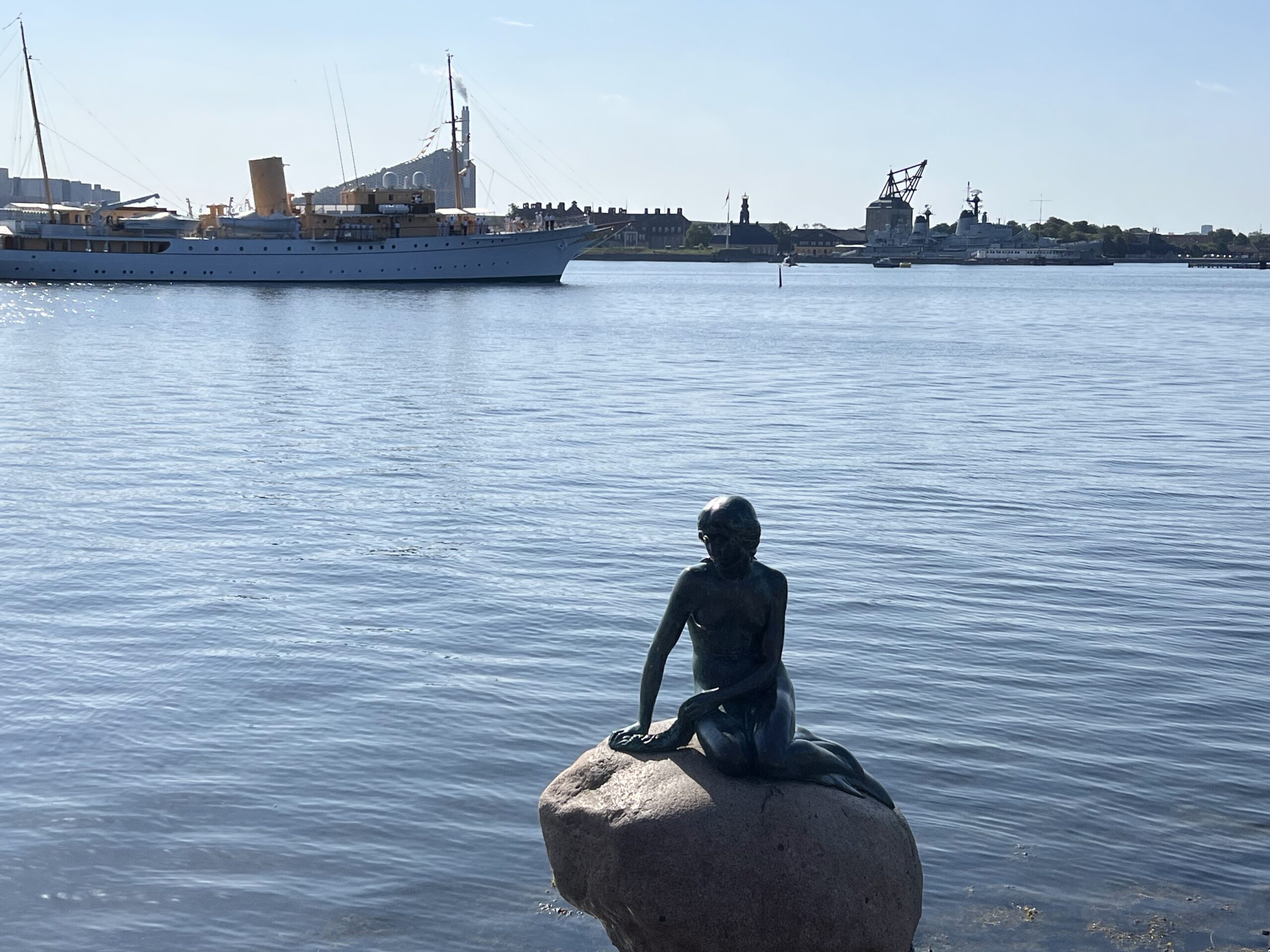
And now, let’s see the statue of the Little Mermaid (Den Lille Havfrue) on its rock by the water in Copenhagen.
It’s the unmissable symbol of Denmark, inspired by the famous Hans Christian Andersen fairy tale.
Be careful, it’s crowded, lots of people!
Not far from the Little Mermaid, there’s a beautiful, green space.
Churchillparken Gardens, with the bust of Winston Churchill, the Gelfion Fountain and the bulls pulling the chariot of the Norse goddess Gefion, St. Alban’s Anglican Church, and the ramparts of Kastellet (Copenhagen Citadel).
We have a drink at Café Spirrevippen, a super nice café located in the Copenhagen Museum.
We visited the Copenhagen Museum (Københavns Museum), which presents the history of the Danish capital since the Middle Ages.
I highly recommend the visit.
 
Right in the center of Copenhagen stands a contemporary, how can I put it… provocative work of art: “Dantes Plads.”
This is a protest project against the construction of a 3-story car park on this square.
Created by Danish artist Jens Galschiøt.
Lunch at Restaurant Karla in Copenhagen (Indre-By), which I highly recommend.
There are some very good Danish dishes, and I ate typical local dishes:
– Marinated herring in cream sauce with dill and capers
– Flæskesteg: Danish roast pork
We’re visiting the National Museum of Denmark, following Copenhagen.
Founded in 1807, it’s Denmark’s largest history museum.
Ideal for discovering Danish history from prehistory to the Vikings, Inuit, and even foreign cultures.
After visiting the Museums, we will see the Palace Hotel Rådhuspladsen, the Dragon Fountain in front of the Politiken building, the dragon statues in front of Copenhagen City Hall, and the entrance to the Tivoli amusement park.
Late afternoon, after visiting the Christiania District, the Little Mermaid, the National Museum of Denmark and Copenhagen, we continue our walking tour through the streets of the Danish capital.
We head back to the hotel, but as soon as we arrive, we see “Green Island CPH”—a must-see!
On the quayside, there’s a huge floating terrace with bars, restaurants, a magnificent view of the canal from the water’s edge, and even a floating sauna!
From there, we even see people diving and then swimming in the canal (after a sauna) and quite a few Danes leisurely cruising on boats or rowing boats.
A trendy and super relaxed atmosphere, rare for a capital city!


