

Saturday 8 July 2023. A quick getaway to Belgium, to Diest: the cobbled lanes, the Diest beguinage, a pot of mussels on a terrace and St Sulpitius’ Church lit up at night.
Setting off for the Diest beguinage, in Flemish Brabant
On 8 July 2023 we set off for a quick getaway to Belgium, heading for Diest (Flemish Brabant, in Flanders). On the road the landscape is surprising: wind farms and solar panels everywhere.


Cobbled lanes, brick houses and windmills
A visit to the town of Diest. I discover a quiet, typically Belgian place: cobbled lanes, brick houses full of character, windmills typical of the north. A natural and simple setting.

The Diest beguinage
A visit to the Diest beguinage. The site is a listed monument, with its statues of nuns, its houses with green shutters, its Art Nouveau style mural and its inner courtyard. Founded in the middle of the 13th century, it has been listed since 1938 and has been a UNESCO World Heritage Site since 1998, together with twelve other Flemish beguinages.

A pot of mussels facing the church
For me it is impossible to go to Belgium without eating a good pot of mussels! A generous and delicious pot of mussels and seafood, with grey shrimps, and a nice cold Tripel from Antwerp to go with it (please note that alcohol is dangerous for your health). And all this on a terrace facing the imposing St Sulpitius’ Church. No booking: we got the last table, by luck.

Diest by night
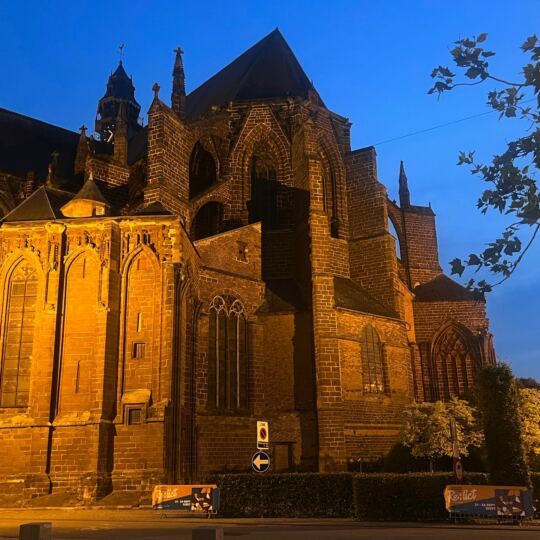
A night-time stroll through Diest. You can see St Sulpitius’ Church, a Gothic gem, under spectacular lighting, with its arches, sculptures and brick facades. There is also the building “De Gulden Boom”, with its red bricks lit up. And to finish, a friendly evening on a terrace, under warm lights. We drink the famous Belgian beers there, but please note: alcohol is dangerous for your health. The next day: the break by the pond on 9 July.
The Diest beguinage, a little town within the town
Beguines were lay women, often widows or unmarried, who lived in a community without taking permanent vows: they could leave the beguinage whenever they wanted. They prayed, but they also worked, for example in textiles or caring for the sick. The movement was born in the Middle Ages in the Low Countries, and Flanders still has the finest examples today (more on the Wikipedia page about beguinages).
Here, the first beguines settled around 1245, on the banks of the Demer, just outside the town walls of the time. Around 1550, the parish priest Nicolas Esch had the old wattle-and-daub houses replaced and laid the whole place out on a grid plan, around St Catherine’s Church, the square and the infirmary. Most of the houses you see today date from the 17th and 18th centuries.
My tip: go early in the morning or late in the day, it is even more peaceful. And remember that people live in the houses: wander around quietly, without making noise.