
Friday 5 January 2024, the first day of my trip to London. The coach from Forbach, the Channel Tunnel, then the Changing of the Guard at Buckingham Palace, Westminster, fish and chips in Whitehall and Trafalgar Square.
From Forbach to London: the coach, the Channel Tunnel and Wembley
Friday 5 January 2024, Oyster card already in hand: I am leaving on an organised coach trip from Forbach with the association “ID Evasion”, heading for London. A passport is now compulsory, and we are asked a few questions at border control in Coquelles, near Calais (purpose and length of stay). Then we board the Channel Tunnel shuttle. As soon as we arrive in the United Kingdom, at a motorway service area, I try some beef jerky, then on to our hotel, the Wembley International Park. Bags dropped off, I head to Buckingham Palace by Tube (Jubilee line) to see the Changing of the Guard of King Charles III.


The Changing of the Guard at Buckingham Palace
A royal day in London. I was lucky enough to watch the Changing of the Guard in front of the majestic Buckingham Palace: a splendid palace, golden statues, green parks with their squirrels and geese, and all the elegance of the mounted parades. If you are passing through London, do not miss the Changing of the Guard! Be sure to check the days and times online before you go.

Westminster and Whitehall: Big Ben, Horse Guards and the women’s memorial
After the Changing of the Guard, I visit Westminster. I discover the best-known monument of the British capital: Big Ben, with its imposing Gothic Revival architecture and its famous chimes. Right next to it stands the classic red telephone box, very popular with tourists for its retro look. I carry on walking and pass the traditional pub “The Red Lion”, then a mounted guard in uniform posted in front of “Horse Guards”. This Palladian building, between Whitehall and Horse Guards Parade, was designed by William Kent and built from 1750 to 1759. I also discover the monument “The Women of World War II”, which pays tribute to the women who took part in the war effort during the Second World War, in particular by taking over the jobs of the men who had gone to the front. This bronze by John W. Mills was unveiled by Queen Elizabeth II on 9 July 2005. I came back to Westminster the next morning: the UK Parliament.

Fish and chips at The Old Shades pub in Whitehall
After Westminster, lunch break. It is hard to find a table: there are five of us and we have no booking. Luckily there is room in a traditional British pub, The Old Shades, in Whitehall. It is a place full of charm and history, with a typically British feel: the present pub, at 37 Whitehall, was built in 1898 and is a listed building. As for me, I had the great English classic, a delicious fish and chips, fried fish and crispy chips, served with three sauces (tartare, ketchup and malt vinegar) and a pint of draught beer. Please drink responsibly: alcohol abuse is dangerous for your health.

Trafalgar Square: Harry Potter shops and Nelson’s Column
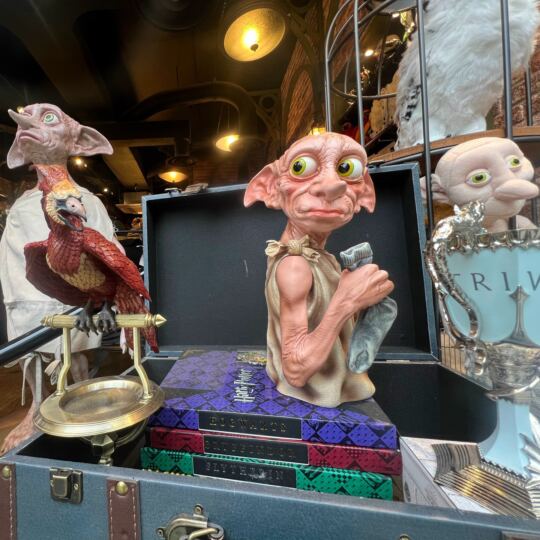
Next I visit the shops around Trafalgar Square. Some have a Harry Potter theme: Dobby the elf in the window, a replica of the famous locomotive 5972. Not far away, another shop displays a red Mini decorated with the Union Jack and a Paddington bear, the London spirit in one window. Then on to the big square, Trafalgar Square, and its historic monuments, with the majestic column of Admiral Horatio Nelson in the middle, a symbol of the British victory at the Battle of Trafalgar on 21 October 1805, a naval battle between the British fleet and the Franco-Spanish fleet. The rest of the day: Covent Garden and Leicester Square. The whole trip: the summary of the three days in London.
Buckingham Palace and the King’s Guard
The ceremony is the moment when the Old Guard hands over to the New Guard, which then protects Buckingham Palace and St James’s Palace. The soldiers usually come from one of the five Foot Guards regiments of the Household Division, with their famous bearskin hats, and they march to the music of a military band.
Buckingham Palace started out as a large townhouse built in 1703 for the Duke of Buckingham. It became the London residence of the British monarch when Queen Victoria came to the throne in 1837, and today it is the monarch’s official residence and administrative headquarters. In front of the railings stands the Victoria Memorial, topped by a gilded winged Victory. My tip: it is always crowded, so arrive well ahead of time to get a spot by the railings or on the steps of the memorial. To find out more, here is the Wikipedia page on the palace.