
Sunday 3 March 2024. A visit to the Cité Sainte-Fontaine, in Freyming-Merlebach, and the forest next to it: a former mining estate where miners’ keepsakes remain, a lamp, some coal, a framed picture of the Peyerimhoff shaft.
Cité Sainte-Fontaine, a mining village next to the forest
A visit to the Cité Sainte-Fontaine in Freyming-Merlebach, on 3 March 2024, and to the forest beside it. Here you find the remains of an industrial past that is still very present in the region. Sainte-Fontaine is a mining estate, and it takes its name from a spring.

A miner’s lamp, coal and the Peyerimhoff shaft
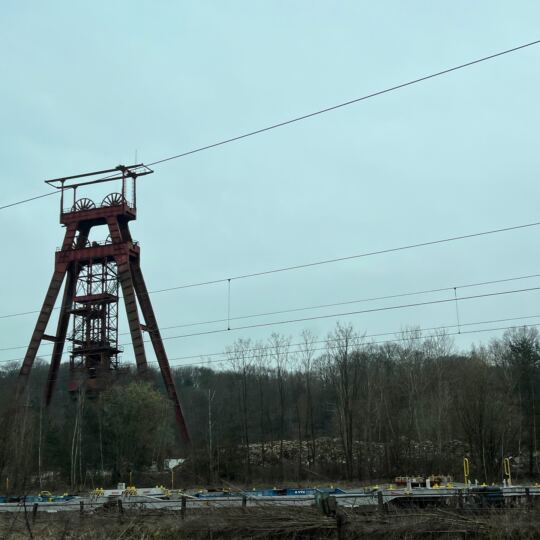
We come across miners’ keepsakes: a miner’s lamp, a lump of coal, a framed picture of the Peyerimhoff shaft, a red-brick factory… Close by, in the commune of Saint-Avold, the headframe of the Sainte-Fontaine shaft, built in 1954, has been a listed historic monument since 1992. Just north of the estate: the Carrière Barrois, which I had seen from above two weeks earlier.
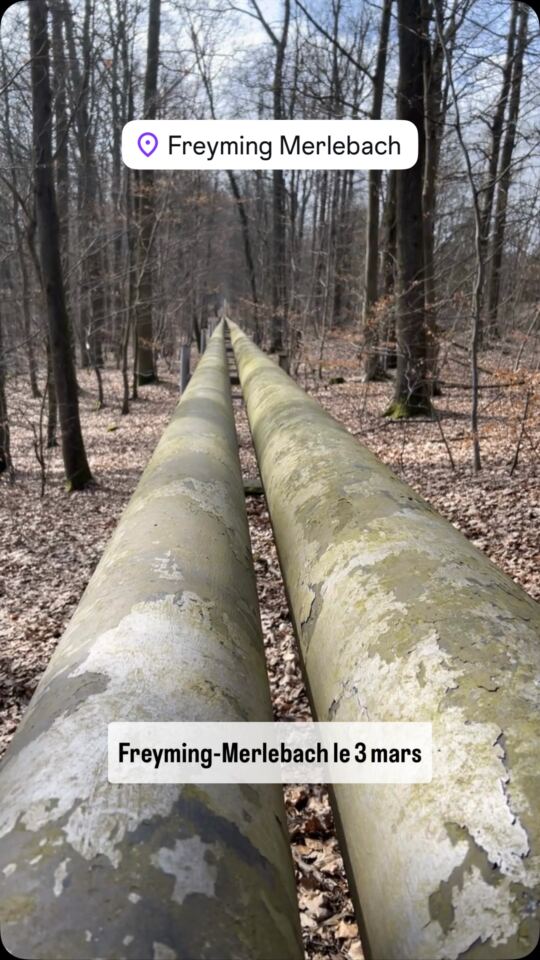
The Lorraine coalfield around Cité Sainte-Fontaine
For decades, Freyming-Merlebach lived to the rhythm of the Lorraine coal mines (Houillères du Bassin de Lorraine). Mining villages such as Cité Sainte-Fontaine were built to house miners’ families, with rows of houses and gardens. The last coal mine in Lorraine, La Houve in Creutzwald, closed in 2004.
Walking through Cité Sainte-Fontaine today means reading this past in the landscape: red bricks, headframes, slag heaps and forests that have grown back. To learn more, the Parc Explor Wendel in Petite-Rosselle tells the story of the miners, and our Moselle page lists more walks. More about the town: Freyming-Merlebach on Wikipedia.
The headframe of the Sainte-Fontaine shaft, built in 1954 in the neighbouring town of Saint-Avold and listed as a historic monument in 1992, remains the most visible landmark of the area. Around it, the forest paths are perfect for a walk of an hour or two, in any season, with family or with the dog.
Bring good shoes: after rain, the forest paths quickly get muddy.