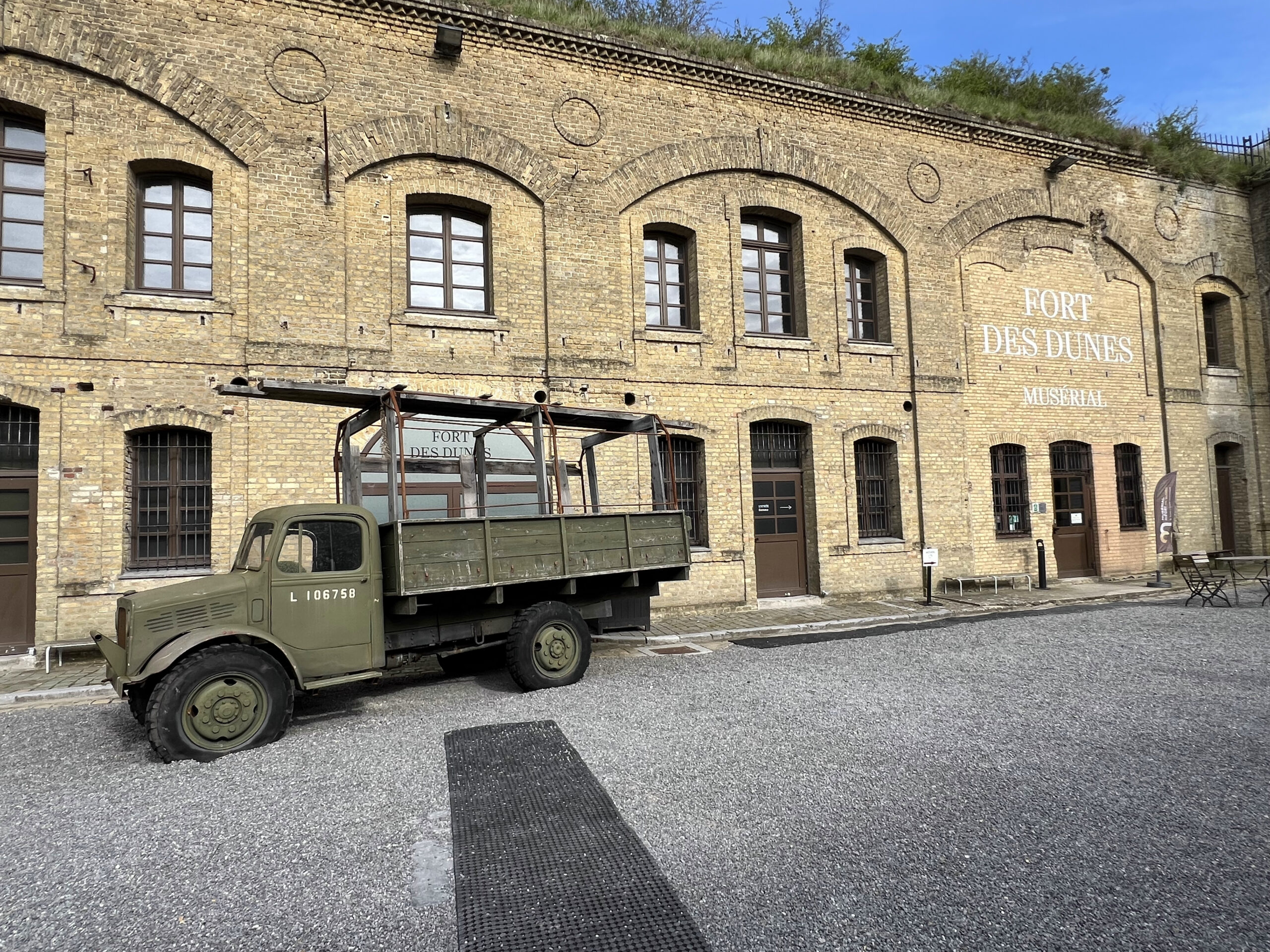
Wednesday 10 April 2024. I visit the Fort des Dunes in Leffrinckoucke, between Bray-Dunes and Dunkirk: a fort built from 1878, a place of remembrance of the Second World War, with a fine view over the dunes from the top.
The Fort des Dunes, a fort from 1878 caught up by June 1940
I am now visiting the Fort des Dunes in Leffrinckoucke, between Bray-Dunes and Dunkirk. It is a place of remembrance of the Second World War, and the visit tells its whole story. The fort was built from 1878 to 1880 to protect the port of Dunkirk. It belongs to the Séré de Rivières system, not to the Maginot Line, which dates from the 1930s. During the Battle of Dunkirk and Operation Dynamo it served as headquarters of the 12th Motorised Infantry Division. Its commander, General Janssen, was killed here by bombs on 2 June 1940.


In the corridors of the fort
Inside you can see the moving reconstruction of life at the time, a corridor full of stories, the architecture of the fort, and also cultural spaces, with an exhibition of bicycles. Then you climb on top of the fort: the view over the region and the dunes is superb.

The view from the top of the fort
Second part of the visit to the historic monument of the Fort des Dunes. Here are the photos I took from the top of the building: there is a magnificent view over the region and over the fort itself. I really recommend visiting this place if you are passing through the north of France. Just after: the Zuydcoote national cemetery. In the morning: the beach of Bray-Dunes, the riders and the seal.

Why visit the Fort des Dunes
The Séré de Rivières system is named after the general who designed it after France’s defeat by Prussia in 1870. The idea: protect the borders and the big ports with a ring of forts, often half buried and covered with earth to stand up better to shells. The fort in Leffrinckoucke is a good example, with its thick walls and vaulted corridors.
What makes it special is that it was built for a war that never came here, and then found itself on the front line sixty years later, during the Dunkirk pocket. So the visit mixes nineteenth-century military architecture with the memory of 1940.
My advice: wear good shoes, because you walk through the galleries and then on the top, and bring a jacket, the wind blows hard up there. With the Zuydcoote cemetery right next door, you can easily do both in the same half day.