
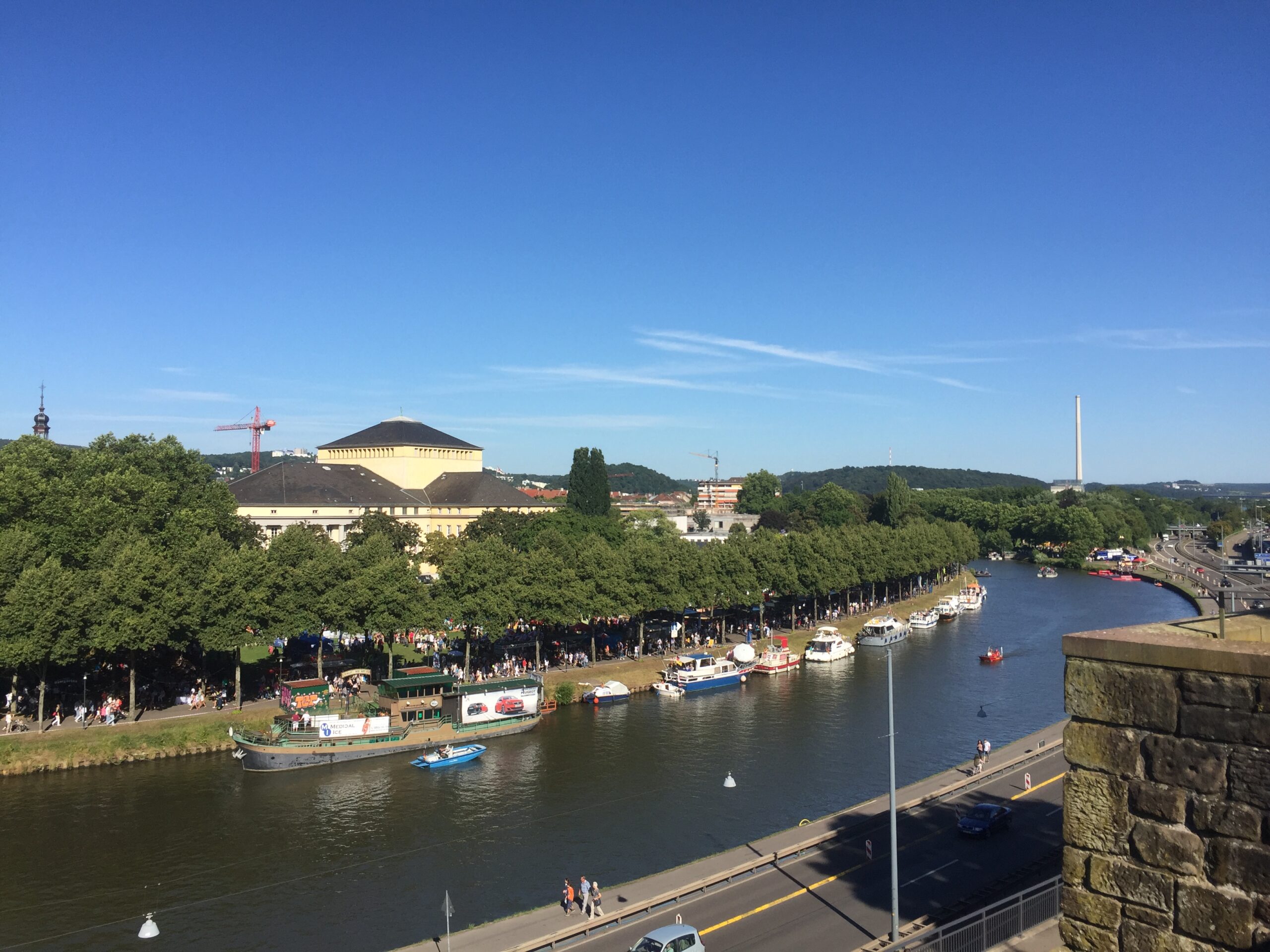
Sunday 7 August 2016. A view of Saarbrücken, the capital of Saarland: the Wilhelm-Heinrich Bridge, the moored barges and the Saarländisches Staatstheater by the river.
The view over the Saar and the Wilhelm-Heinrich Bridge
A superb view of the capital of Saarland: the Wilhelm-Heinrich Bridge, the barges and the Saarländisches Staatstheater, the state theatre, opened in 1938. I have often been back to Saarbrücken since, for example for the Franco-German Garden in Saarbrücken on 14 September 2025.


The Wilhelm-Heinrich Bridge, in the heart of Saarbrücken
The Wilhelm-Heinrich Bridge is the main road bridge in the centre of Saarbrücken. It links the St. Johann district, with the station and the shopping streets, to Alt-Saarbrücken, the old town around the castle. The current structure dates from the early 1960s: it replaced a steel bridge destroyed at the end of the Second World War.
Its name honours Prince William Henry of Nassau-Saarbrücken, who ruled in the 18th century. He is the one who turned Saarbrücken into a baroque town, with his architect Friedrich Joachim Stengel: they gave the city its castle and the Ludwigskirche, a really beautiful Protestant church. It is one of the most important Protestant baroque churches in Germany.
A little further along, the Alte Brücke, an old stone bridge from the 16th century, is for pedestrians only. On the riverbank you can also see the Saarkran, a reconstruction of an old quayside crane. The Saar is navigable, which is why barges are moored right in the city.
On the St. Johann side, St. Johanner Markt is the liveliest square in the old town, with its terraces and its baroque fountain, also designed by Stengel. The Saarländisches Staatstheater, right by the water, puts on opera, plays and dance. And since the French border is only a few kilometres away, lots of people from the Moselle come over for the day.
Saarbrücken is the capital of Saarland, the German state next to the Moselle. The present city was created in 1909 by merging Saarbrücken, St. Johann and Malstatt-Burbach. My tip: the walk along the Saar between the two bridges is easy to do on foot. For the city’s history, see the Saarbrücken page on Wikipedia.