

Sunday 18 February 2024. After Wildpark Karlsbrunn, I climb through the Warndt forest to the viewpoint above the Carrière Barrois: a former quarry, on the French side, now a protected natural area.
From Wildpark Karlsbrunn to the Carrière Barrois viewpoint
After Wildpark Karlsbrunn, I keep walking in the Warndt forest (part of the Natura 2000 network on the German side). It climbs, but it is not far, and you reach a superb view over the Carrière Barrois.

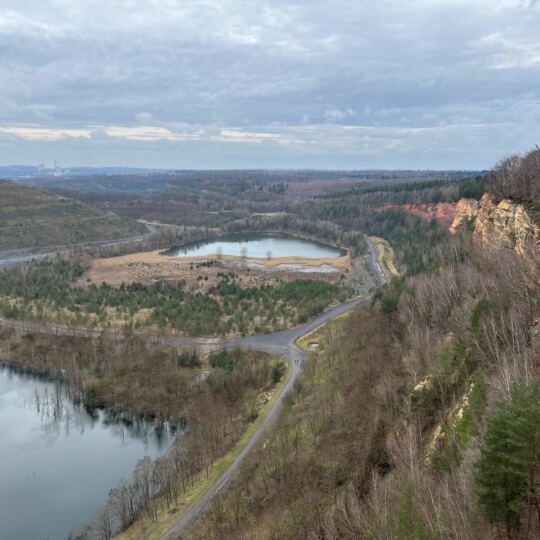
A former quarry handed back to nature
This former quarry, now a protected natural area, has become a haven of peace that draws many hikers, nature lovers and photographers. The view really is magnificent: steep rocky cliffs, stretches of woodland and very clear pools of water. The quarry lies on the French side, in Freyming-Merlebach, and the cliff along its northern edge marks the border. The sandstone dug here was used to backfill the mine galleries. It stretches over 4 kilometres.
The Warndt-Wald-Weg
The Warndt-Wald-Weg passes by this viewpoint. It is a hiking trail of about fifteen kilometres through the Warndt forest, starting from Karlsbrunn, one to do if you like nature and the outdoors. I came back to the area: to the Cité Sainte-Fontaine, on the other side of the quarry, and to Karlsbrunn in April.
The Carrière Barrois: where the name comes from, and my tips
The Carrière Barrois takes its name from the geologist Charles Barrois, and from a mine shaft that was named after him. It is the largest of the former quarries of the Lorraine coalfield, and it spreads over several towns: Freyming-Merlebach, L’Hôpital and Saint-Avold. Sandstone and sand were dug here, a yellow to red sandstone that crumbles easily.
Because this rock is soft, rain, wind and frost slowly sculpt it: you can see columns of rock known as hoodoos, or fairy chimneys. The site is also a refuge for rare species, such as the Eurasian eagle-owl and the green toad, which is why it is protected.
My tips: wear good shoes, as the ground is sandy and the path climbs, stay on the trails and keep away from the edge of the cliffs. Bring binoculars too if you like birdwatching. To find out more about the area, here is the Wikipedia page on the Warndt.