
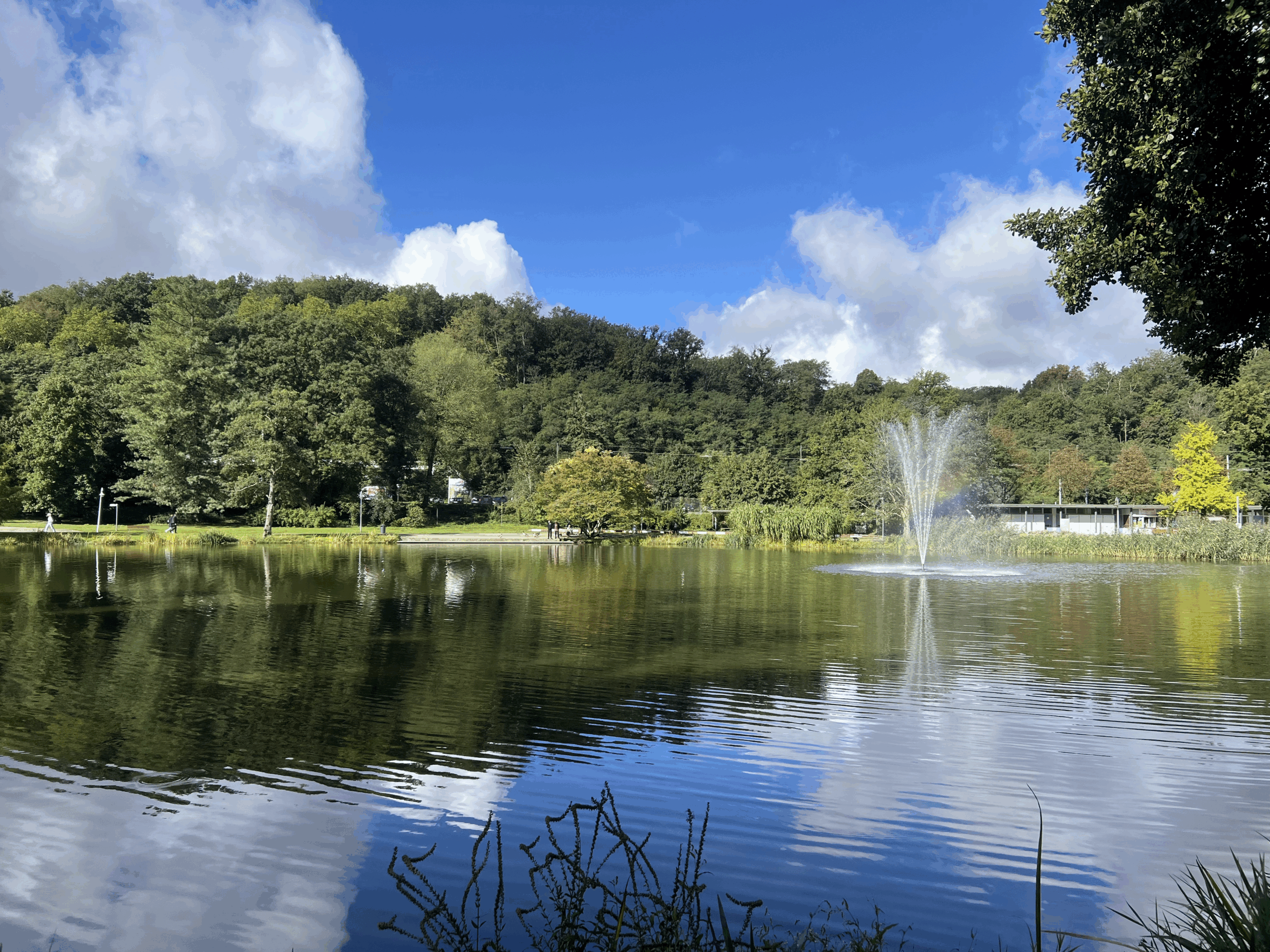
Sunday 14 September 2025, a short walk in the Franco-German Garden in Saarbrücken, the Deutsch-Französischer Garten, in Germany, right on the border with France.
The Franco-German Garden in Saarbrücken, a park made for relaxing
It is the perfect place to unwind. There is a large lake and plenty to do: pedal boats, a small cable car, mini golf, several restaurants and even a casino. You also come across a lot of animals roaming free.


Bunkers and a cemetery from the 1870 war
We carry on walking, because the park is also a historic site. There are many Second World War bunkers, and even an old cemetery with the graves of German soldiers, and French ones too, from the Franco-Prussian War of 1870 and the First World War.

Currywurst and schnitzel at the park restaurants
A visit here is always a chance to make the most of the park’s restaurants. Several serve local specialities, for example currywurst or schnitzel.

The history of the Franco-German Garden in Saarbrücken
The park lies on the south-western edge of Saarbrücken, right by the Goldene Bremm border crossing, a stone’s throw from Stiring-Wendel and Forbach. It covers around fifty hectares around a large pond, the Deutschmühlenweiher, and you can walk there from the old part of town (Alt-Saarbrücken).
The Franco-German Garden in Saarbrücken was opened in 1960 by Chancellor Konrad Adenauer and French Prime Minister Michel Debré. It was a joint garden show, designed by German and French landscape architects, to symbolise the friendship between the two countries after the Saarland returned to Germany. Many locals still call it « die Gartenschau ».
The place is also steeped in history. In 1870 the land was part of the battlefield below the Spicheren heights. The cemetery of honour, at the top of the park, remembers the soldiers who fell on both sides, and it holds the grave of Katharine Weißgerber, known as « Schultze Kathrin », who rescued wounded German and French soldiers alike during the battle. The bunkers were part of the Westwall, the line of fortifications Germany built opposite the Maginot Line.
My tip for a walk in the Franco-German Garden in Saarbrücken: come on a sunny day and allow a good half-day, because there’s plenty to do between the pond, the little cable car and the flower gardens. To find out more, here is the Deutsch-Französischer Garten page on Wikipedia (in German), and my other outings across the border are gathered on my Saarbrücken page.