

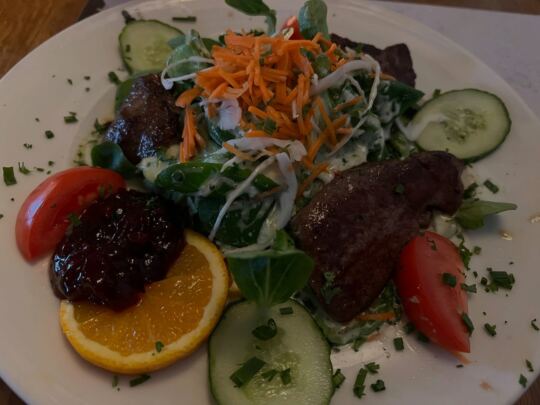
Venison medallions, Hirschmedaillons in German, are a great classic of German game cooking, served mainly in autumn and winter during the hunting season. Thick slices are cut from the loin or the topside of red deer, a very lean meat with a delicate flavour, and seared quickly so they stay pink. They come with a red wine sauce scented with juniper, lingonberries (Preiselbeeren) whose sweet sharpness balances the game, and here a lamb’s lettuce salad, the Feldsalat eaten everywhere in Saarland and south-west Germany.
On 11 November 2024, I had this dish in Saarbrücken at Tante Maja, a restaurant and brasserie I found super good. On the menu: Hirschmedaillons aus Feldsalat und Preiselbeeren, venison medallions with lamb’s lettuce and cranberries.
This is not the restaurant’s recipe, but the classic recipe for German-style venison medallions. It is of medium difficulty: everything depends on a short, precise cooking time and on resting the meat. A probe thermometer is a great help for a pink centre.

The recipe
Classic recipeThe traditional recipe for the dish, not the one from the restaurant where I tasted it.
Ingredients
Medallions and sauce
- 600 g trimmed venison loin or topside
- 2 tablespoons clarified butter or neutral oil
- 4 juniper berries, crushed
- 1 sprig of thyme
- 100 ml full-bodied red wine
- 200 ml game stock or brown veal stock
- 1 tablespoon lingonberry jam
- 20 g cold butter
- Salt and freshly ground pepper
Lamb's lettuce salad
- 150 g lamb's lettuce
- 40 g walnut halves
- 3 tablespoons walnut or sunflower oil
- 1.5 tablespoons cider vinegar
- 1 teaspoon mustard
- 1 teaspoon honey
To serve
- 100 g lingonberries in syrup or lingonberry jam (Preiselbeeren)
Method
- Take the meat out of the fridge 30 minutes before cooking. Remove any remaining membrane and cut 8 medallions about 3 cm thick. Preheat the oven to 80 °C with a plate inside.
- Wash and dry the lamb's lettuce carefully. Toast the walnuts in a dry pan for 3 to 4 minutes, then chop roughly. Whisk the oil, vinegar, mustard, honey, salt and pepper into a dressing.
- Heat the clarified butter in a frying pan over high heat. Sear the medallions for 2 to 3 minutes per side without moving them, with the juniper and thyme, until well browned. The centre should reach 55 to 58 °C for pink meat.
- Season the medallions with salt and pepper, place them on the warm plate, cover with foil and leave to rest for 5 minutes in the oven: the juices settle and the meat stays tender.
- In the same pan, deglaze with the red wine, scraping up the browned bits, and reduce by half. Add the stock and reduce for another 5 to 6 minutes until syrupy. Remove the thyme and juniper, stir in the lingonberry jam, then whisk in the cold butter in small pieces off the heat. Adjust the seasoning.
- At the last moment, toss the lamb's lettuce with the dressing and walnuts. Serve two medallions per plate, spoon over the sauce, add a spoonful of lingonberries and the salad on the side.
Tips and variations
- Red deer can be replaced with roe deer loin (cook slightly less) or fallow deer.
- Never pierce the meat while it cooks and only salt it after searing so it stays juicy.
- For a heartier winter meal, add buttered spätzle or potato croquettes.
- If you cannot find lingonberries, cranberry sauce or redcurrant jelly works well.
Recipe shared for guidance only, adapt it to your equipment: times and temperatures may vary. Check for allergens (gluten, milk, eggs, fish, shellfish, nuts, sesame…) and make sure ingredients are fresh. Raw or undercooked fish, meat and eggs are not recommended for pregnant women, young children, elderly or vulnerable people. Take care with hot oil, flambéing and alcohol. I am not a health or nutrition professional.