

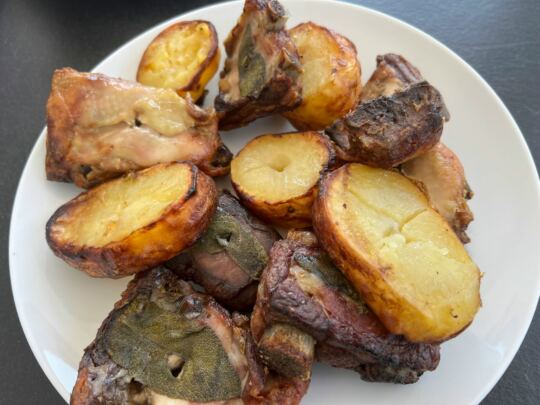
Spiedo bresciano is the Sunday dish of the valleys of the province of Brescia and the Lombard shores of Lake Garda. Pieces of pork, chicken and rabbit are threaded onto long spits, alternating with sage leaves, then roasted very slowly for five to six hours in front of embers or in a rotisserie, while being basted constantly with melted butter. The potatoes cook in the juices dripping from the spit, and everything is served with polenta.
I tasted it on Sunday 20 August 2023 at Lake Garda. I had ordered it several days in advance from the Macelleria e Polleria Moschini butcher’s shop in Gardola (Tignale). It is a typical local meal dating back to the Middle Ages, cooked on a spit with several meats, pork, chicken and rabbit, and potatoes.
This is not the butcher’s recipe, but the classic spiedo bresciano recipe, adapted for an oven with a rotisserie or a barbecue rotisserie. It is hard mainly because of its length: you have to watch and baste the meat for several hours. You will need long spits and a tray to catch the juices.

The recipe
Classic recipeThe traditional recipe for the dish, not the one from the restaurant where I tasted it.
Ingredients
Meats
- 800 g pork neck (coppa) in 5 cm cubes
- 600 g pork ribs cut into 2-rib pieces
- 1 free-range chicken of 1.3 kg cut into 12 pieces
- 1 rabbit of 1.3 kg cut into 12 pieces
- 40 fresh sage leaves
- 20 g fine salt
Cooking
- 250 g butter
- 1 kg small waxy potatoes
Polenta
- 500 g polenta cornmeal
- 2 litres water
- 15 g coarse salt
Method
- Salt all the meat on every side and leave in the fridge for 2 hours, then take it out 30 minutes before threading so that it comes back to room temperature.
- Thread the pieces tightly onto the spit, alternating pork, chicken and rabbit, with a sage leaf between each piece. Put the fattiest pork pieces at the ends: as their fat melts, it bastes the rest. If you use several spits, share the meats out evenly.
- Fit the spit into an oven with a rotisserie preheated to 160 °C (or onto a barbecue rotisserie over gentle indirect heat), with a large tray underneath to catch the juices. Melt the butter in a small pan.
- Turn the spit slowly for 4 to 4 and a half hours, basting the meat with melted butter every 15 to 20 minutes, then with the juices from the tray. The meat should brown very gradually without ever burning: lower to 150 °C if it colours too quickly.
- Peel the potatoes and put them in the tray under the spit 1 and a half hours before the end, turning them now and then in the juices and butter until golden and tender.
- During the last hour, make the polenta: bring the salted water to the boil, pour in the cornmeal while whisking, then cook over a low heat for 45 minutes, stirring often, until it pulls away from the sides.
- Check that it is done: the rabbit and chicken should come away easily from the bone and the juices should run clear. Remove from the spit, arrange the meat, crispy sage and potatoes on a large platter, spoon over the juices and serve with the hot polenta.
Tips and variations
- Without a rotisserie, thread the meat onto metal skewers laid across a roasting tin and roast at 160 °C for 3 and a half hours, turning and basting every 20 minutes.
- The old version also included small birds, which are now protected; today only pork, chicken and rabbit are used.
- Serve with a local red wine such as a Groppello from the Valtenesi, or a Franciacorta if you prefer bubbles.
Recipe shared for guidance only, adapt it to your equipment: times and temperatures may vary. Check for allergens (gluten, milk, eggs, fish, shellfish, nuts, sesame…) and make sure ingredients are fresh. Raw or undercooked fish, meat and eggs are not recommended for pregnant women, young children, elderly or vulnerable people. Take care with hot oil, flambéing and alcohol. I am not a health or nutrition professional.