
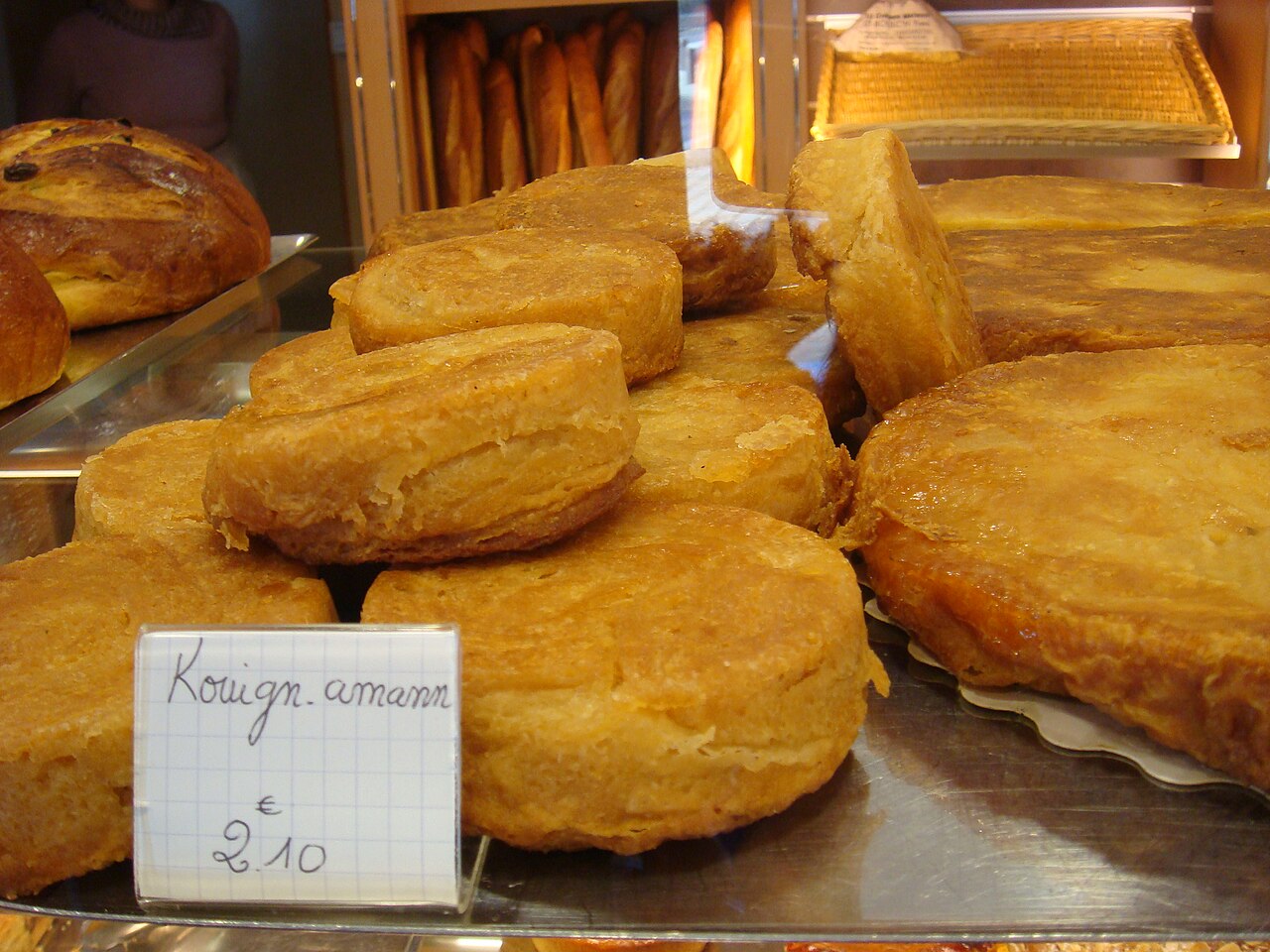
This kouign-amann recipe is for the famous Breton cake whose name means butter cake in the Breton language. It was born in Douarnenez, in Finistère, in the 19th century: a laminated bread dough with lots of salted butter and sugar that caramelises in the oven into a shiny, crunchy crust.
It is a specialty I really want to show you. It takes a bit of patience because the dough has to be folded several times, yet the result is spectacular: soft in the middle and caramelised on the edges.
Here is the traditional version, with only a few basic ingredients: flour, water, yeast, lightly salted butter and sugar.
The recipe
Classic recipeThe traditional recipe for the dish, not the one from the restaurant where I tasted it.
Ingredients
Dough
- 250 g strong bread flour
- 150 ml lukewarm water
- 7 g instant dry yeast (1 sachet)
- 5 g fine salt
Butter and sugar
- 200 g cold salted butter
- 200 g caster sugar (50 g of it for the tin)
- a little butter for the tin
Method
- In a large bowl, mix the flour, salt and yeast, then add the lukewarm water. Knead for 8 to 10 minutes until the dough is smooth and supple. Cover and let it rise for 1 hour at room temperature, until doubled in size.
- Put the cold butter between two sheets of baking paper and flatten it with a rolling pin into a square of about 15 cm. Keep it in the fridge while you roll out the dough.
- Roll the dough into a rectangle of about 30 x 20 cm. Put the butter square in the middle, fold the two sides over it to enclose it and pinch the edges well. Rest for 15 minutes in the fridge.
- Roll the dough into a 40 x 20 cm rectangle, sprinkle it with 50 g of sugar, then fold it in three like a letter. Chill for 20 minutes. Do this fold three times in total, with 50 g of sugar each time.
- Butter a 20 cm round tin generously and sprinkle the bottom and sides with the remaining 50 g of sugar. Roll the dough into a square of about 25 cm, then fold the four corners into the centre to make a small parcel. Place it in the tin.
- Let it rise for 30 minutes at room temperature. Meanwhile, preheat the oven to 200 °C.
- Bake for 10 minutes at 200 °C, then lower to 180 °C and bake for another 30 minutes, until the top is deeply caramelised. If it colours too fast, cover with aluminium foil.
- Turn it out right away, otherwise the caramel sticks to the tin. Let it cool a little on a rack before eating.
Tips and variations
- The butter must stay cold but pliable: too hard and it breaks the dough, too soft and it leaks out.
- Put the tin on a baking tray: butter and sugar can overflow while baking.
- Best eaten warm on the same day. The next day, 5 minutes in the oven at 160 °C brings back the crunch.
- It keeps for 2 days in a tin at room temperature.
Recipe shared for guidance only, adapt it to your equipment: times and temperatures may vary. Check for allergens (gluten, milk, eggs, fish, shellfish, nuts, sesame…) and make sure ingredients are fresh. Raw or undercooked fish, meat and eggs are not recommended for pregnant women, young children, elderly or vulnerable people. Take care with hot oil, flambéing and alcohol. I am not a health or nutrition professional.
Photo: Syced, CC0, via Wikimedia Commons